











Lithuanian prosecutors have completed a pretrial investigation into the desecration of a monument to anti-Soviet resistance leader Adolfas Ramanauskas-Vanagas, alleging that three foreign nationals carried out the act under orders from Russian military intelligence.
The Kaunas Regional Prosecutor’s Office announced Wednesday that the three suspects – dual Estonian-Russian citizens and a Russian citizen, born in 1982, 1987, and 2005 – are accused of acting on behalf of Russia’s GRU, the military intelligence agency. All three were residing in Tallinn and were arrested by Estonian authorities. They are currently being held in custody in Lithuania.
Charges include assisting a foreign state in actions against the Republic of Lithuania, destruction or damage of property, and desecration of a grave or public memorial site.
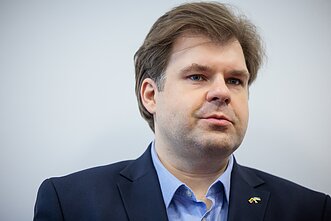
“This was not a spontaneous or random act,” said Rimas Bradūnas, chief prosecutor of the Kaunas Regional Prosecutor’s Office, at a press conference. “The individuals conducted reconnaissance and surveillance before selecting the monument as a target.”

Bradūnas said the suspects acted in an organised group and were promised financial compensation for carrying out the vandalism. One of the three has partially admitted guilt, while the other two deny the charges.
The incident took place in January 2024 in the town of Merkinė, in southern Lithuania’s Varėna District, where the monument to Ramanauskas-Vanagas was splashed with paint.
The act was reported by the director of the Merkinė Regional Museum. A similar monument in the village of Bielėnai, in the Lazdijai District, was also vandalised with paint in May 2023, although no suspects were previously identified in that case.
Lithuanian President Gitanas Nausėda warned in March 2023 that such attacks on national symbols – including monuments and flags – were being planned and coordinated outside the country, and could continue.

Adolfas Ramanauskas-Vanagas was a schoolteacher who joined the anti-Soviet partisan resistance in 1945 following the Soviet occupation of Lithuania. He became one of the most prominent commanders in the movement.
In 1948, he was appointed commander of the Southern Lithuanian partisan region and later served as deputy to Jonas Žemaitis, chairman of the presidium of the Lithuanian Freedom Fighters’ Union. In early 1950, he became the head of the Union’s Defence Forces.
Ramanauskas-Vanagas withdrew from active armed resistance in the early 1950s and went into hiding with his family until he was captured in 1956. He was tortured and executed by the KGB in Vilnius in 1957.

Newsletter
Every Friday morning.